Optical Determination of Contact Forces Using FTIR
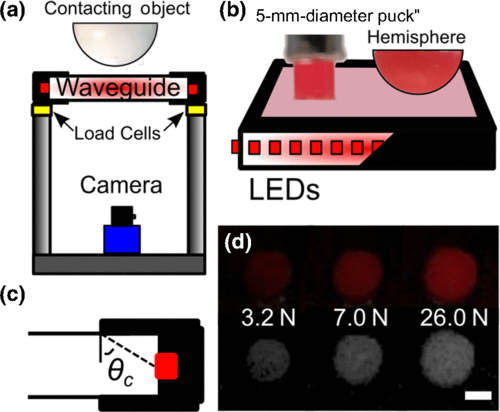
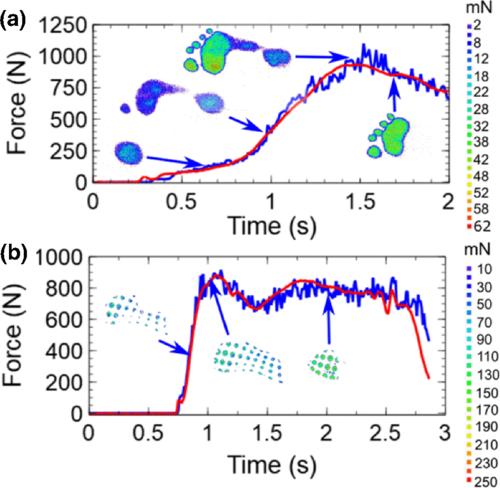 My supervisor at the time and I measured the contact forces of a sports shoe as a pressure map over time using a piece of perspex, some LEDs, some black tape and a camera. Some load cells were used to calibrate the system. It took much investigation to determine the properties which effect the brightness of light emitted from the waveguide, which was simply made from LEDs, perspex and black tape. The paper linked below details the experiment and derives the mathematics required to describe the interactions.
Abstract:
"A simple device based on the principle of frustrated total internal reflection is used to image the regions of contact between rubber objects and a large-area perspex waveguide. Measurements of the intensity of light scattered at the interface are found to depend upon the magnitude of the applied force, the mechanical properties of the contacting material, and the roughness of the contacting objects. The intensity-force response is found to have the same functional dependence irrespective of the position on the waveguide surface, but to scale by an amount that is proportional to the local intensity of light incident on the perspex-object interface. Once this spatial variation in intensity is calibrated, the waveguide can be used to perform optical measurements of the forces/pressures exerted on the surface of the waveguide and to generate spatial maps of the pressure at frame rates up to 200 Hz. The resulting optical force platform is used to measure the time-dependent evolution of the pressure distribution beneath a foot and a sports shoe during a foot-strike event. A simple theory is developed to describe the light-scattering phenomenon and to explain the relationship between the scattered light intensity and the applied force."