Spin Flop in Uniaxial Antiferromagnet CuMnAs

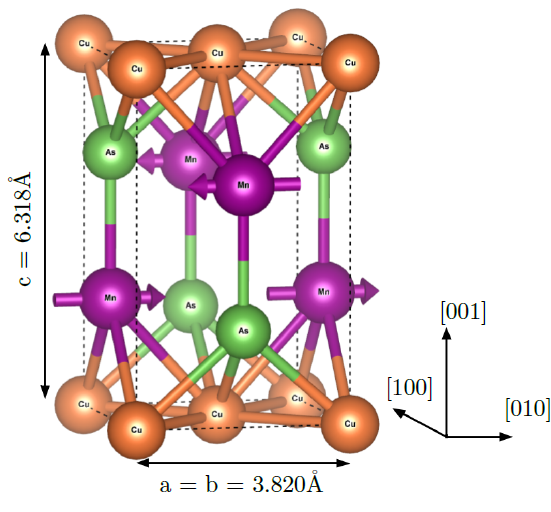
For my MSci final year project, my lab partner and I investigated spin flop in antiferromagnetic CuMnAs. Spin flop is a sudden ninety degree rotation of the magnetic axis followed by a small canting toward the field in an antiferromagnetic material when the field is applied parallel to the antiferromagnetic axis, sometimes referred to as the "L-vector" or "Néel Vector". This occurs when the energy penalty of the anti-parallel moment is larger than the energy penalty for both moments to be off axis and slightly canted. The report linked below is a summary of our investigations and results showing that spin flop occurs at a relatively low field (around 2T) for our layer of CuMnAs. The report also included experimental simulations and temperature dependence of resistance measurements which were used to further probe spin flop in our material.
We explore some of the properties of the antiferromagnetic material CuMnAs. This is done through a combination of spin-flop measurements, zero field anisotropic resistance measurements and a series of numerical models. The spin flop field is measured in CuMnAs to be Bsf = 1.48 ± 0.04 T for one of our material samples, and Bsf = 1.44 ± 0.04 T for the other. The results from these works, when combined with XMLD-PEEM images, were used to determine the exchange energy density and anisotropic energy density in CuMnAs in two limits. The first model, derived by considering two moments in free space, yielded an exchange field strength of 220 ± 50 T and anisotropy field strength of 5±2e−3 T. The second model, considering a moments in the bulk, provided an exchange field of 80 ± 20 T and anisotropy field of 1.7±0.5e−3 T. In the course of our project also obtained a number of simulation results applicable to antiferromagnets more widely.
Unit cell of CuMnAS, the antiferromagnetic material used in the experiment.